Vaհe H. Apelian
 |
| Dawn of Armenian Pop Music by Boghos Shahmelikian Translated by Vahe H. Apelian |
Let me note that the text posted below is the introduction I wrote for my translation of Boghos Shahmelikian’s book titled “Յիշատակներ եւ Անցած Օրեր” – “Memories and Bygone Days”.
"Sometime in 2016, I visited Abril Bookstore in Glendale, California. I can safely say that I hardly miss attending this landmark Armenian bookstore whenever I am in Los Angeles. While browsing for a few books in Western Armenian to read, Arno, the owner of the bookstore, presented me Boghos Shahmelikian’s book.
I had not hear of the book before, even though this was its second edition and had several good reviews. The book is titled ““Յիշատակներ եւ Անցած Օրեր” - (Yishadagner ew Antsʿadz Ōrer) – “Memories and Bygone Days”.
The cover of the book attracted my attention. It depicted many of the popular Armenian singers I knew growing up I Lebanon. I purchased a copy. I can say that I read its 220 pages literally in one breath.
The book is fascinating account of the evolution of the post Genocide Armenian contemporary popular music in the Diaspora, commonly referred to as pop music. The Armenian term is estradayen.
Starting from early 1960’s a host of Armenian singers and musical bands appeared on stage in Lebanon. They started singing western songs such as in French, English, Italian and Spanish and ended up singing in Armenian popularizing Armenian music throughout the Diaspora. The Armenian songs they sand were not always new. However, for the first times non-traditional instruments, such as electric guitar, drum-sets, electronic organ (Keyboards), saxophone and the like accompanied the songs. The “invasion” of these musical bands lasted until the mid 1970’s and tapered off with the onset of the Lebanese Civil War.
Boghos Shahmelikian’s narrative of the era is not exhaustive or complete. The family names of some of the musicians elude the author’s memory. There are not many resources to search about the period. The lack of material may have to do with the contemporary neglect of the budding culture.
It would take years, if not decades, for the Armenian Diaspora institutions to realize that these young men and women revolutionized Armenian song and in doing so enormously popularized Armenian music and ushered it away from its Ottoman influences. It is this later day realization that drove Catholicos Aram I of the Great House of Cilicia to bestow upon Armenian popular singers Adiss Harmandian, Levon Katerjian, and Harout Pampoukian the ecclesiastical or of Saint Mesrob Mashdots. The order is named after the priest who invented the Armenian alphabet in the fourth century.
Boghos Shahmelikian’s narration also portrayed aspects of the dynamics of the intra communal relations of the young in Lebanon. Their cooperation transcended sectarian based political animosities inherent in the mosaic of the Lebanese social fabric, and instead coalesced in music. Finally, the narration also depicted the devastating effect of the civil war in Lebanon.
The author’s intimate knowledge of the era would have been lost had it not been for his foresight to pen his remembrances in his book. His is the only account that encapsulates the period that in hindsight was the Diaspora Armenian Musical Spring. The fact that Boghos, as a musician, was part and parcel of the period makes his narration authoritative and entertaining as well.
The book is in Western Armenian. It is composed of two parts. The first part deals mostly with the author’s personal experiences playing with the popular The Five Fingers band and with other vocalists and musicians. The second part of the book is an overview of the many, mostly Armenian singers and the music bands of the period that he personally knew.
It is fair I thought that the book be available in English as well, primarily for the benefit of the children and the grandchildren of these young musicians who are mostly born and raised on the western shores and cannot read in Armenian anymore. The narration is also no less a primary source of information of that period. I asked and was generously given permission by the author to translate his book. Hence this translation came about.
Readers who might have read the book in Armenian may find the text expanded with footnotes. These were added to best portray the time and the era to those who did not live throught it. Boghos and his friend Vahig Vartabedian, a musician himself, reviewed and approved the accuracy of the translation in its entirety.
Last but not the least, I would like to thank my cousin Jack Chelebian M.D. for editing my translation. Jack is younger than I. He is born and raised in Lebanon. In his student days he worked as a pharmacy technician in the pharmacy oLevon Karamanoukian owned in Dhour Shoueir, where many of the singers and music bands mentioned in the book performed. He is an astute observer as well. Without his help and comments I would not have been able to adequately translate Boghos Shahmelikian’s book. The title of the book – “Dawn of Armenian Pop Music” – is Jack’s wording."
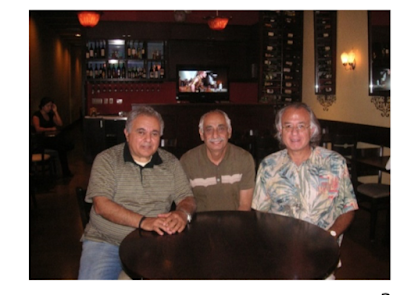 |
| LtoR: Vahe H. Apelian, Boghos Shahmelikian, Jack Chelebian |

No comments:
Post a Comment